In this article+
- 01Choose the formality before the colour
- 02Four useful choices, each with a different job.
- 03Tonal socks make the leg line simplest
- 04Use texture as the quiet alternative
- 05Make one coloured sock answer the outfit
- 06Go sockless only when the outfit is clearly casual
- 07Use enough length when you sit
- 08Check material, care and shoe fit
01
Choose the formality before the colour
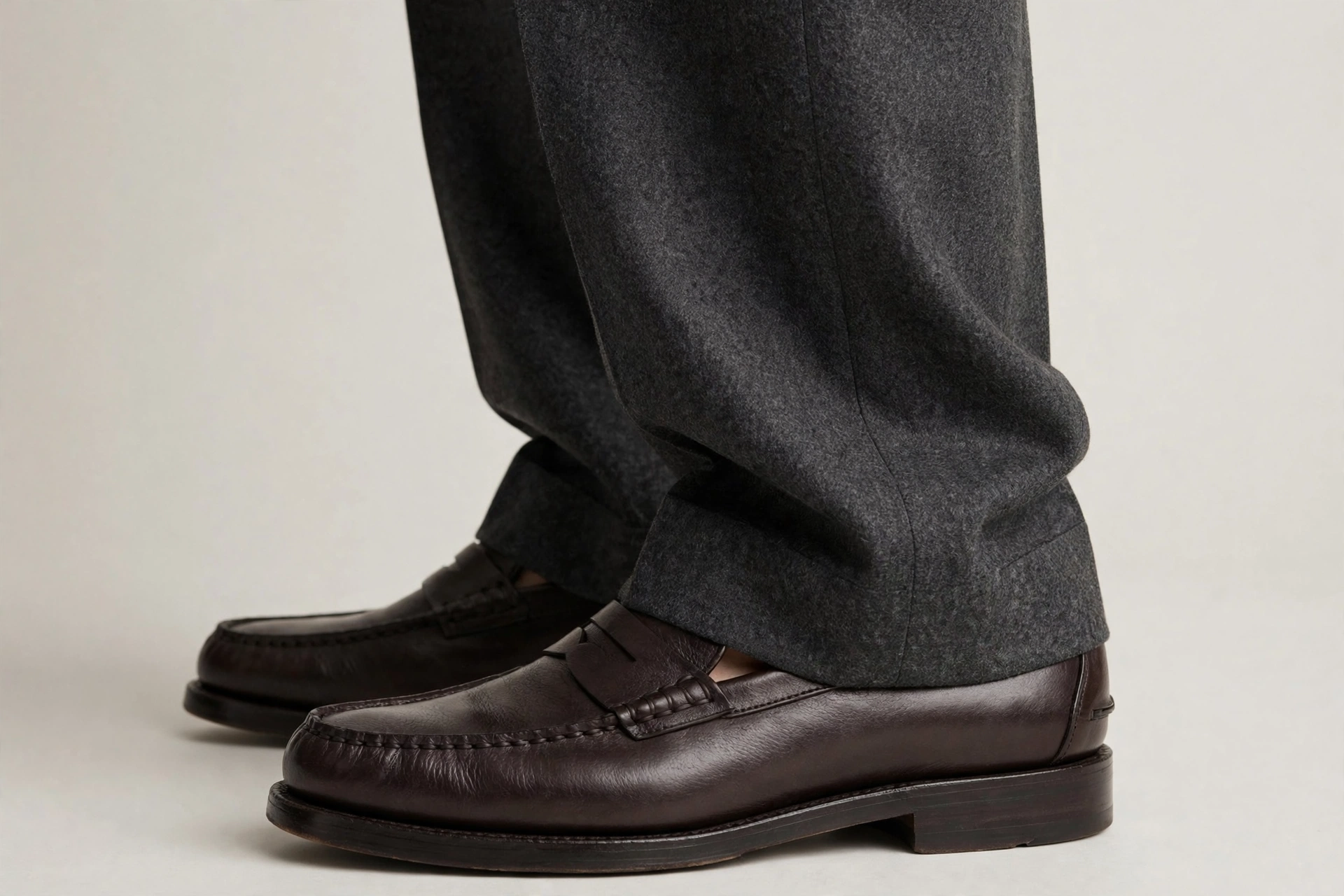
A polished loafer with tailored trousers usually needs a proper dress sock. A soft suede loafer with cotton trousers can be more relaxed, while a summer loafer worn with linen or shorts may justify an apparently sockless look. Decide whether the outfit is tailored, smart casual or genuinely warm-weather casual before choosing a pattern or colour.
02
THE LOAFER-SOCK ROUTES
Four useful choices, each with a different job.
Start with the trouser and setting, then choose a sock whose colour, texture and thickness support both.
| Route | Works with | Useful choice | Avoid |
|---|---|---|---|
| Tonal | Tailoring and smart casual trousers | Same family as the trouser | A sharp contrast at the ankle |
| Textured | Flannel, corduroy and suede | Fine rib or subtle marl | A bulky sock in a sleek loafer |
| Restrained colour | Simple neutral outfits | Burgundy, forest or muted blue | Novelty becoming the whole outfit |
| No-show | Warm-weather cotton, linen and shorts | Liner fully hidden below the vamp | Visible ankle socks or formal settings |
03
Tonal socks make the leg line simplest
Matching the sock broadly to the trouser extends the visual line when the hem lifts. Navy trousers with navy socks and charcoal trousers with charcoal socks are reliable because the ankle does not become a new focal point. An exact dye match is unnecessary; a slightly darker tone often looks more deliberate and wears more easily.
04
Use texture as the quiet alternative
Fine ribbing, a subtle marl or a dry wool surface adds interest without introducing bright colour. Keep the gauge compatible with the loafer: a sleek leather penny loafer wants a fine sock, while a chunkier suede or country loafer can take more texture. The sock still needs to fit the shoe comfortably without compressing the toes.
05
Make one coloured sock answer the outfit
Burgundy, forest green, tobacco or muted blue can work when the colour is repeated or supported elsewhere. The goal is connection, not novelty. Avoid a very bright sock becoming the only thing visible between two quiet garments, and treat bold motifs as a focal accessory rather than a default rule.
06
Go sockless only when the outfit is clearly casual
The practical version of sockless is a low-cut liner that remains below the loafer opening, controls moisture and reduces friction. Pair it with cotton or linen trousers, relaxed tailoring or shorts—not a formal business suit. The trouser length must look intentionally clean, and the loafer lining must still be comfortable in warm conditions.
07
Use enough length when you sit
With long trousers, the sock should cover the calf when seated so no strip of skin appears between sock and hem. Over-the-calf socks are the most reliable solution; a well-fitting long mid-calf pair may also work. Test them after walking because socks that slide down can turn a sound choice into an untidy one.
08
Check material, care and shoe fit
Merino regulates temperature well, cotton feels familiar and linen blends can suit warm weather, but construction and fit matter as much as fibre. Keep toenails smooth, rotate shoes and let loafers dry between wears. A thicker sock changes the internal fit; if the shoe is already close, do not force a textured winter sock into it.
SOURCES & FURTHER READINGThe references behind this guide+
- Put This On — Finding the perfect loafer
- Put This On — Guide to going sockless
- Put This On — Shoes and socks with a navy suit
- QWD guide — What shoes to wear with chinos
QWD applies these references as a practical menswear baseline. Garment design, body proportions and intended styling can justify a different choice.