In this article+
- 01The trousers have not changed length
- 02Read the trouser-and-shoe symptom.
- 03What shoe volume actually means
- 04How the contact point changes the break
- 05Length and leg opening are one decision
- 06Cloth changes how clearly the problem appears
- 07Use a two-shoe fitting-room test
- 08Diagnose the symptom before altering
- 09One hem does not have to serve every shoe
01
The trousers have not changed length
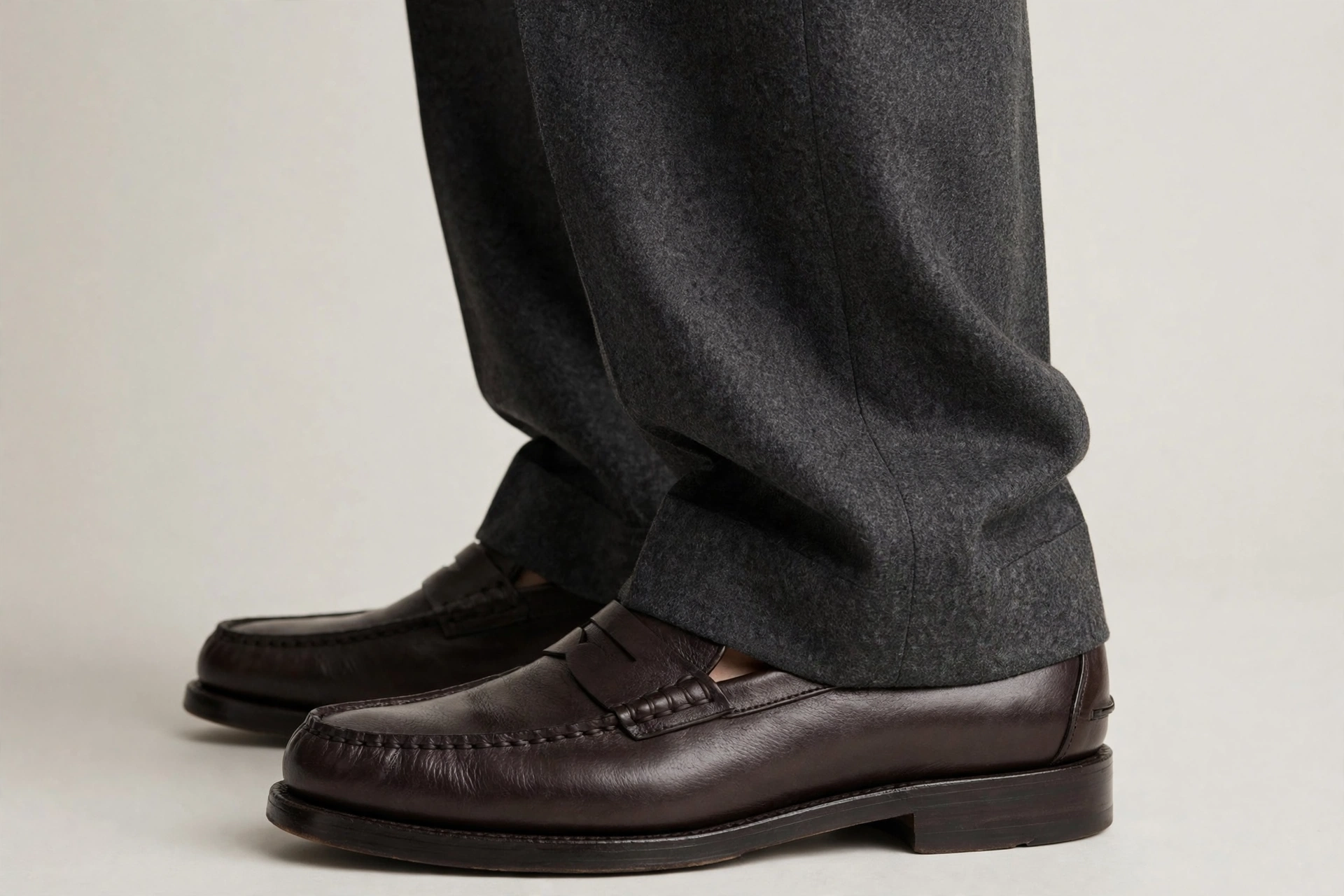
If the same trousers look clean over a Derby but pool over a loafer, the shoe is part of the explanation. Trouser break—the fold created where the hem meets the shoe—is a relationship between both pieces. A fuller shoe catches the cloth earlier. A sleeker shoe exposes more of the hem and lets it descend farther. That is why trousers can look bad with one pair of shoes and balanced with another even though the waistband, rise and inseam are identical.
02
DIAGNOSE BEFORE ALTERING
Read the trouser-and-shoe symptom.
Test the same trousers with two real shoes before changing the hem. The symptom often points to contact, opening or scale rather than inseam alone.
| Symptom | Likely cause | Check | Action |
|---|---|---|---|
| Pools on loafers; clean on boots | The boot supports the hem earlier | Compare vamp and toe-box height | Shorten for low shoes or assign the trouser |
| Catches on boot laces | Opening may be too narrow | Watch the hem while walking | Try a wider opening before adding length |
| Drags at the rear with every shoe | Excess length or low waistband | Reset the waist and view from behind | Correct position, then hem |
| Shoe disappears without extra folds | Visual scale mismatch | Compare welt and sole width | Use more shoe volume or less opening |
03
What shoe volume actually means
Volume is not simply whether a shoe is a loafer, Derby or boot. Look vertically at the instep, vamp slope and toe-box depth; horizontally at the forepart, welt and outsole projection; and separately at sole thickness. A loafer can be generous and high-walled, while a lace-up can be narrow and low. Judge the actual last and construction in front of you, not the category name printed on the box.
04
How the contact point changes the break
A low vamp and shallow toe allow the front hem to travel farther before it rests, so more cloth may fold above the shoe. A higher instep or deeper toe supports the hem sooner and can make the same trouser appear shorter and cleaner. A broad welt also gives a wider leg opening something to relate to visually. This is straightforward geometry rather than a claim that one shoe type is always better.
05
Length and leg opening are one decision
A narrower opening usually needs less length because it reaches the shoe sooner and has less room to fall around it. Add too much length and the hem may perch on laces or catch on a boot instead of dropping after you stand. A fuller opening can carry more length and a controlled break, but it may visually swallow a very fine shoe. Set opening, length and footwear as one proportion—not three independent choices.
06
Cloth changes how clearly the problem appears
Flannel and other cloths with body can hold a crease and recover after movement, while light or very soft cloth collapses more readily around the shoe. Turn-ups add useful weight but limit the option of a slanted hem. A plain hem can be cut slightly lower at the back to reduce front break while retaining coverage. Cloth cannot rescue a poor length decision, but it changes how strongly every fold is seen.
07
Use a two-shoe fitting-room test
Wear the trousers at their normal waist position and bring the lowest- and highest-volume shoes you realistically plan to use. Check front, side and rear while standing naturally, then walk, sit and stand again. Look for one controlled front break at most, no fabric dragging at the rear and a hem that releases rather than catching. If both shoes remain clean, you have a useful compromise. If one clearly fails, assign the trousers to one footwear family.
08
Diagnose the symptom before altering
Clean on boots but pooling on loafers usually means the hem is relying on the bulkier shoe for support. Clean on loafers but caught on boot laces often points to an opening that is too narrow, not a need for more length. Rear dragging with every shoe suggests excess length or a waistband-position issue. If the shoe disappears without extra folds, the problem may be visual scale rather than the hem itself. Twisting on one side can point to posture or trouser balance.
09
One hem does not have to serve every shoe
A no-break trouser is less physically dependent on the shoe because it does not rest heavily on the upper, although the visual balance still changes. Fuller trousers and heavy boots may need a different setting from narrow trousers and low loafers. When two footwear families demand materially different lengths or openings, separate trousers are more disciplined than one compromised hem. Fit the garment for the combinations you actually wear most.
SOURCES & FURTHER READINGThe references behind this guide+
- Edward Sexton — Savile Row bespoke fittings
- Carmina — How a shoe last affects fit
- Loake — Shoe lasts and styles
- Permanent Style — Trouser length and break
QWD applies these references as a practical menswear baseline. Garment design, body proportions and intended styling can justify a different choice.